
You're looking at battery options, and every quote seems to land on a different number: one system, two, sometimes more. It's hard to tell whether you're being sold more than you need or not quite enough.
It's a fair question, and the honest answer is that it depends on what you actually want the battery to do.
How many batteries your home needs comes down to how much you want backed up and for how long, not your square footage or a one-size-fits-all package. Two houses on the same street in Wilmington can land on very different answers depending on what's on the backup circuit and how long they want it to last.
As a local, turnkey team, Cape Fear Energy Systems designs home battery storage systems sized around how you actually want to use them rather than a generic package. Here's how battery sizing really works, what different backup goals tend to require, and how to think through the decision before you buy.
Quick Answer: How Many Batteries Does a Home Need?
It depends on your backup goals more than the size of your house:
- One battery can be enough to keep a set of essential circuits running through a typical outage, including refrigeration, lighting, internet, outlets, and in some cases limited HVAC support
- Two batteries provide more stored capacity and available output for longer outages or larger loads like a well pump
- Larger backup goals, including whole-home air conditioning, a pool pump, or an EV charger on the backup circuit, may require additional capacity and should be sized around the home's actual equipment and energy use
Battery capacity also varies more than most homeowners expect. Many popular whole-unit batteries fall around the 13.5 to 15 kilowatt-hour (kWh) range, but that's not universal. Among the systems we work with, the Tesla Powerwall provides 13.5 kWh of usable capacity, the FranklinWH aPower 2 provides 15 kWh, Enphase IQ Batteries can be configured using 5 kWh modules, and Generac PWRcell systems can range from 9 to 18 kWh per cabinet.
Those are product capacities, not a formula for how many your house needs. The right number still depends on your specific loads, goals, and how you expect to use the system during an outage.
Start With What You Actually Want the Battery to Do
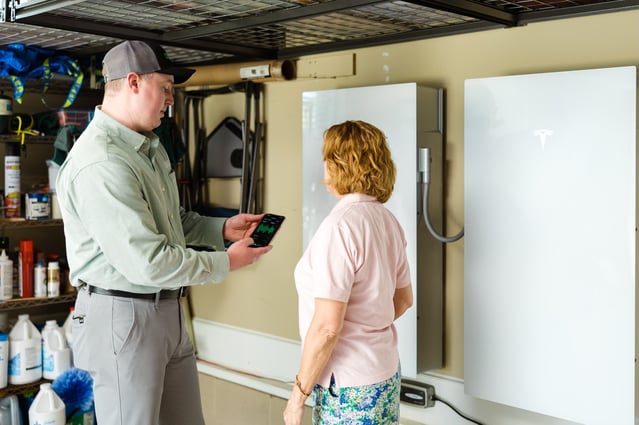
Before you can size a battery system, it helps to define the goal. Are you mainly trying to avoid a dark house during a summer thunderstorm? Ride out a multi-day outage after a hurricane? Or lean on the grid less during expensive peak hours?
Each of those calls for a different amount of stored capacity, which is why "how many batteries do I need?" doesn't have one universal answer.
That question isn't hypothetical here. According to the U.S. Energy Information Administration, American electricity customers averaged 11 hours of interruptions in 2024, and customers in South Carolina "experienced longer service interruptions than in any other state, at nearly 53 hours in 2024," largely due to Hurricane Helene.
A battery sized for a two-hour thunderstorm outage is a very different system than one meant to carry a home through a multi-day storm recovery.
You also don't necessarily need every circuit in the house backed up. Many homeowners care most about refrigeration, lighting, internet, essential outlets, and enough heating or cooling support to stay comfortable. Getting specific about what matters most is what turns a vague "how many do I need?" into an actual sizing plan.
What Actually Determines the Right Number
There are sizing formulas floating around online, and they tend to make this look simpler than it really is. The right number depends on which specific circuits you want backed up, how those loads behave when they kick on, how long you want them running, whether solar is recharging the system during the day, and what you're willing to do without if an outage stretches into a second or third day.
A refrigerator, a few lights, and a Wi-Fi router are the easy part. Central air conditioning, a well pump, or an electric range behave differently, and what a load draws at startup matters as much as what it draws steadily. A well pump that runs quietly most of the time can still demand a surge of power the moment it cycles on.
That's the part a simple sizing formula tends to miss.
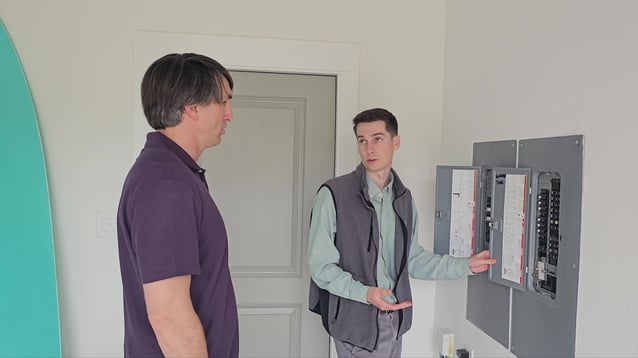
It's why we'd rather walk your home, look at your panel, and talk through what you actually want running than hand you a worksheet and hope the number lands. If you want more background first, our guide to how home battery storage works explains how these systems store and discharge power.
Plan your home battery system
Not sure how many batteries your home actually needs?
As a turnkey, NABCEP-certified local team, we review your home's real energy use and goals before recommending a system size, not the other way around. Let's look at the full picture together.
Get a Free EstimateOne Battery, Two Batteries, or More: What Changes
A single battery can be enough for homes that mainly want essential circuits covered during a typical outage: refrigeration, some lighting, internet, a few outlets, and potentially limited HVAC support depending on the equipment and battery system.
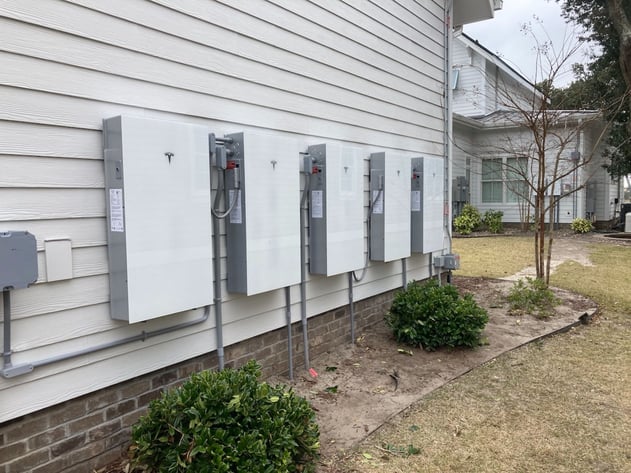
Adding a second battery increases stored capacity and may also increase how much power the system can deliver at once, depending on the equipment. That can create more room for longer runtimes, larger loads like a well pump, or more flexibility during an extended outage.
Homes with larger backup goals, including a pool pump, EV charger, or whole-home air conditioning, may need more capacity than that. The right number depends entirely on which loads you want covered and for how long.
None of these are guarantees of a specific runtime. Actual performance depends on your home's loads, the weather, how much solar production is available for recharging, and how the system is used during the outage.
If runtime is the part you're really trying to figure out, our guide to how long a home battery can power your house during an outage goes deeper into that side of the equation.
Will a Battery Run My Air Conditioning?
For Carolina homeowners, this is often the question behind the question. The answer is: it can, but whether it makes sense depends on the battery system and the air conditioner.
Air conditioning is one of the largest loads in a home, and compressors can require a significant amount of power when they start. Whether a battery can start and continue running your system depends on the HVAC equipment, how much output the battery system can provide, and what else is drawing power at the same time.
A newer, high-efficiency variable-speed system and a properly matched battery present a very different sizing situation than an older single-stage unit paired with a smaller battery system.
That's also why battery planning sometimes needs to include the HVAC system itself. If replacing an older air conditioner is already on your radar, it may make more sense to plan your backup system around the equipment you'll actually be using long term rather than sizing around a system you expect to replace soon.
If cooling is one of your top backup priorities, the efficiency of your HVAC system should be part of the battery-sizing conversation from the start.
Why Planning This Alongside Solar Matters
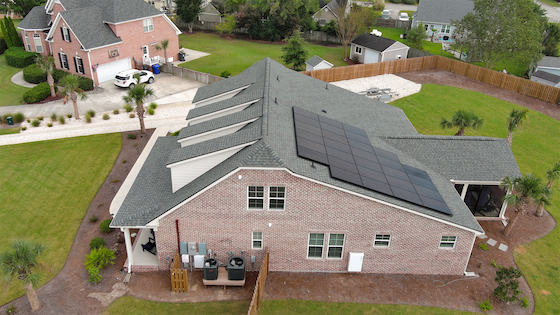
Battery storage can be especially useful when it's planned as part of a whole-home energy system rather than as an isolated purchase. A battery paired with solar can recharge from available sunlight during the day and discharge as needed, while a battery without solar depends on another available energy source for recharging. During a multi-day outage, that distinction can matter.
A detail that surprises a lot of homeowners is that solar panels by themselves won't necessarily keep your lights on. As the Department of Energy puts it, "Technically, residential solar panels alone are not enough to make your home resilient." Grid-tied solar systems are generally designed to shut down when the grid goes down for the safety of the crews working to restore power.
It takes the right system configuration, which can include battery storage and compatible equipment, for solar energy to remain available to the home during an outage.
That's why home batteries are often planned alongside solar panels, allowing stored energy to be replenished when sunlight and system conditions permit. And if you're also weighing a generator, HVAC upgrades, or an EV charger, it's worth planning battery capacity around the whole picture instead of one piece at a time.
Adding an EV charger two years from now changes your home's energy profile, and it's far easier to account for future loads during design than to discover later that the original system wasn't designed around them.
Let's Size This Right, Together
There's no universal number of batteries every Carolina home needs. The right answer comes from walking through your goals, your essential loads, and your home's specific setup with a team that designs the system around the way you actually want to use it.
We've been doing that here since 2007, and we'd rather get the sizing right up front than have you discover a gap during the next outage.
Your local partner in energy independence since 2007
Ready to find the right battery system for your home?
As a turnkey, NABCEP-certified local team, we design whole-home energy systems, solar, battery, generators, HVAC, and EV charging, across NC and SC.
Get a Free Estimate