Project Snapshot
- System Size: 217.58 kW
- Panels: 506 semi-transparent, frameless modules
- Annual Production: 282,560 kWh
- Primary Objective: Reduce operating expenses and integrate solar into a high-visibility civic space
- Installation Type: Solar canopy with glass integration
- Notable Feature: Architecturally integrated, semi-transparent solar canopy
The Client & Operational Context
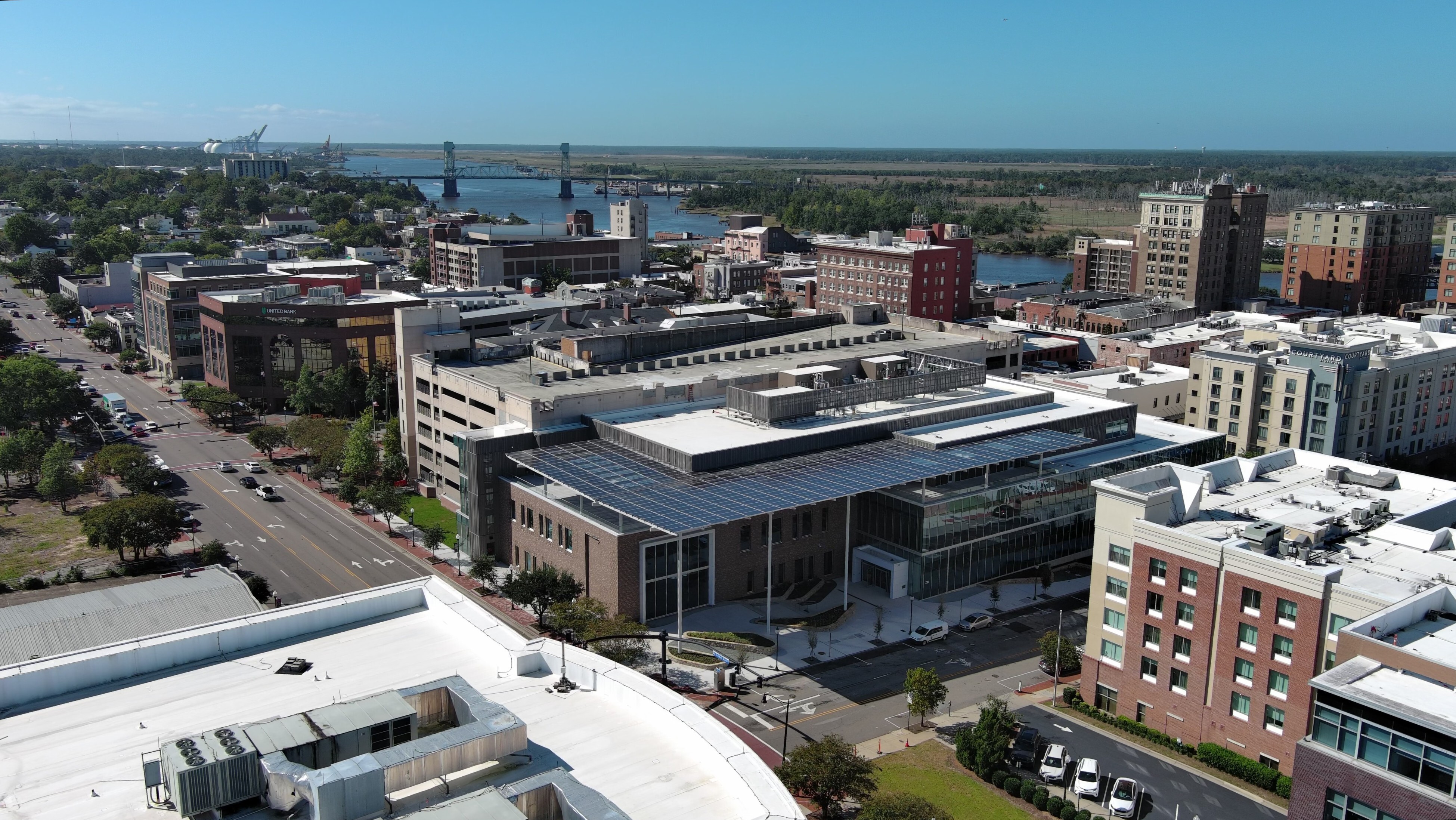
Project Grace is a 95,000-square-foot civic development in downtown Wilmington, bringing together the New Hanover County Public Library and the Cape Fear Museum into a shared cultural and educational campus. Designed as a central gathering space, the project emphasizes accessibility, community engagement, and experiential learning.
From the outset, the solar canopy was intended to serve a dual purpose. It needed to generate clean energy while also acting as a visible, educational feature that introduces visitors to renewable energy in a tangible way. This required a solution that aligned with both the building’s performance goals and its architectural vision.
The Challenge
This project combined architectural ambition with technical complexity. The canopy design called for semi-transparent, frameless solar panels installed alongside glass panels, allowing natural light to pass through to the space below. Without traditional panel framing, waterproofing became a critical challenge, requiring precision installation to ensure long-term durability.
The downtown location added further constraints. The jobsite required careful coordination in a dense urban environment, including the use of tall lifts, sidewalk closures, and ongoing navigation of an active construction site surrounded by public infrastructure.
The Strategy
Design-Integrated Solar
The system was developed to align with the architectural vision, using semi-transparent panels that balance energy production with natural light transmission.
Precision Installation Approach
Special attention was given to waterproofing and panel integration, ensuring long-term performance without compromising the design intent.
Urban Logistics Coordination
Installation required detailed planning to manage equipment access, pedestrian safety, and coordination with other trades in a tight downtown footprint.
Experiential Energy Design
The canopy was positioned as more than an energy system. It serves as an interactive feature that introduces visitors to solar technology in a real-world setting.
The Solution
The final installation consists of a 217.58 kW solar canopy made up of 506 semi-transparent, frameless panels integrated with glass elements. The system is projected to generate approximately 282,560 kWh annually while maintaining the visual and functional goals of the space.
By combining solar with architectural design, the canopy creates a shaded public area that supports both energy production and community use. The system is seamlessly integrated into the structure, demonstrating how solar can be incorporated into complex, design-forward projects.
The Results
Financial Impact
The system offsets a portion of the facility’s energy consumption, contributing to long-term operational savings while supporting the building’s overall efficiency strategy.
Operational Impact
The canopy provides on-site energy generation while functioning as a structural and aesthetic element of the campus. The system was successfully integrated despite complex design and site constraints, ensuring reliable performance over time.
Community Impact
Project Grace introduces renewable energy directly into a public, high-traffic environment. The canopy serves as a visible example of solar in action, and planned educational components will help students and visitors understand how photovoltaic systems work.
The system is expected to offset more than 418,000 pounds of CO₂ annually, reinforcing the project’s role as a sustainability leader within the Wilmington community.
System Performance Snapshot
- 217.58 kW solar canopy system
- 506 semi-transparent, frameless panels
- 282,560 kWh annual energy production
- Integrated glass and solar design
- Over 418,000 pounds of CO₂ offset annually
Why It Matters
This project demonstrates how solar can extend beyond rooftops and become part of the built environment. By integrating renewable energy into a civic space, Project Grace shows how infrastructure can serve both functional and educational purposes.
It also highlights the importance of execution. Design-driven systems require a high level of coordination and precision, especially in urban environments. Successfully delivering this project reinforces how solar can be adapted to complex architectural visions without compromising performance.
.jpg)