If you've been considering solar, you've probably heard that net metering is changing in North Carolina.
For some homeowners, that news has created uncertainty. Does solar still make sense? Are the savings going away? Should you wait? What happens after 2026?
The reality is that solar remains one of the most effective ways to reduce your long-term energy costs. However, the rules governing how solar homeowners are credited for the energy they produce are evolving. Understanding those changes now can help you make a more informed decision and potentially lock in a more favorable rate structure before important deadlines arrive.
Whether you're considering your first solar installation or already have solar and want to understand your options moving forward, here's what you need to know about Duke Energy's net metering changes and how they could affect your savings.
What Is Net Metering?
Net metering is the billing structure that determines how Duke Energy credits homeowners for the electricity their solar systems produce.
During the day, your solar panels power your home first. If your system produces more electricity than you're using at that moment, the excess energy is sent back to the grid.
Historically, Duke Energy customers received a one-to-one retail credit for that exported energy. Many homeowners think of the electric grid as a "virtual battery." Excess solar production is sent to the grid during the day, and those credits help offset electricity used later at night or during periods of lower solar production.
The value of those credits is what has made net metering such an important part of solar economics in North Carolina.
Why Is Net Metering Changing?
The changes stem from North Carolina House Bill 589, which authorized utilities to develop new solar billing structures.
Duke Energy argued that homeowners with solar were paying less toward maintaining the electric grid because they purchased less electricity from the utility. The result was a series of approved changes that created new interconnection programs for solar customers.
The transition has already begun and will continue through the end of 2026.
The good news is that homeowners still have options. Understanding those options is the key to maximizing savings.
Understanding Duke Energy's Three Solar Billing Structures
Legacy Net Metering
Legacy net metering applies to customers who installed solar before October 1, 2023.
Under this structure:
- Excess solar production receives full retail credit.
- There are no time-of-use rates.
- Credits are carried forward throughout the year.
- Remaining credits are reset during the annual true-up period in May.
Legacy customers will remain on this structure through December 31, 2026.
Net Metering Bridge Rider
The Net Metering Bridge Rider was created as a transition program between legacy net metering and Duke Energy's future billing structure.
For many homeowners, this is currently the most attractive option.
Under the Bridge Rider:
- Energy produced and consumed during the billing cycle still receives one-to-one retail value.
- Net excess production is credited at Duke Energy's wholesale rate.
- Customers receive value for all energy produced.
- The rate structure can be locked in for up to 15 years.
Most importantly, new solar customers can still enroll in Bridge Rider through the end of 2026, assuming capacity remains available.
Residential Solar Choice
Residential Solar Choice is Duke Energy's long-term replacement for traditional net metering.
This program introduces time-of-use billing.
Instead of all electricity being valued equally throughout the day, electricity costs vary based on when it is consumed.
Higher rates apply during peak demand periods, while lower rates apply during off-peak hours.
For homeowners who understand their usage patterns and leverage battery storage, significant savings opportunities still exist. However, the structure is more complex than traditional net metering.
| Feature | Legacy Net Metering | Net Metering Bridge Rider | Residential Solar Choice |
|---|---|---|---|
| Available to New Solar Customers: | No | Yes (through Dec. 31, 2026, subject to capacity) | Yes |
| Retail Credit for Energy Used During Billing Cycle: | Yes | Yes | Yes |
| Excess Energy Compensation: | Annual true-up; remaining credits reset in May | Wholesale credit (~$0.04/kWh) for net excess production | Wholesale credit (~$0.04/kWh) for net excess production |
| Time-of-Use Rates: | No | No | Yes |
| Critical Peak Pricing: | No | No | Yes |
| Monthly Minimum Bill: | Approximately $16 | Approximately $28 (DEP) / $22 (DEC) | Approximately $28 (DEP) / $22 (DEC) |
| Battery Benefits: | Primarily backup power and resiliency | Backup power plus improved energy management | Significant savings potential through load shifting and peak avoidance |
| Rate Structure Certainty: | Ends Dec. 31, 2026 | Up to 15 years from eligibility date | Subject to future rate schedule changes |
| Complexity: | Low | Low | Moderate to High |
| Best Fit For: | Existing grandfathered customers | Homeowners going solar before 2027 | Homeowners comfortable managing time-of-use energy consumption |
What Happens After 2026?
This is the question most homeowners are asking.
For prospective solar customers, the Net Metering Bridge Rider enrollment window closes at the end of 2026.
After that point, Residential Solar Choice will become the primary option for new Duke Energy solar customers.
For homeowners who secure a place on Bridge Rider before the deadline, the benefit is certainty. You know how your solar production will be credited and can maintain that structure for years into the future.
As electricity rates continue to rise, that predictability becomes increasingly valuable.
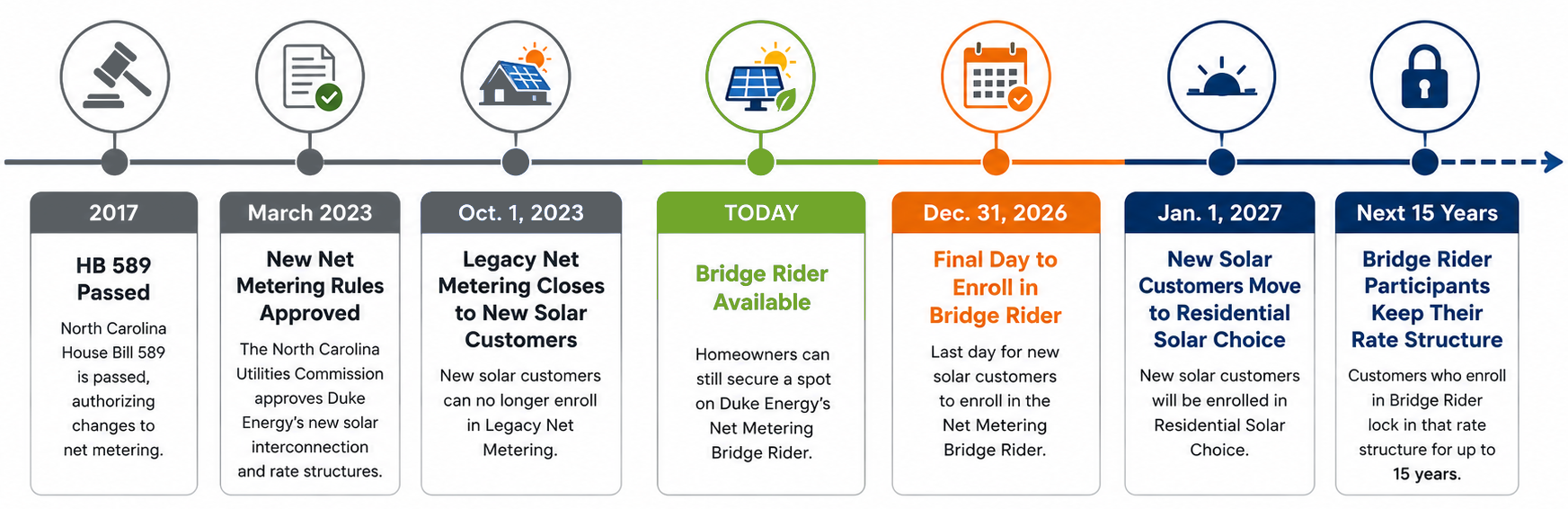
Key Takeaway: Homeowners who install solar before the end of 2026 may still qualify for Duke Energy's Net Metering Bridge Rider and lock in that billing structure for up to 15 years.
Is Solar Still Worth It?
In a word: yes.
In fact, rising utility rates may make solar more valuable than ever.
Duke Energy recently proposed another significant rate increase of 18.1%, continuing a trend that homeowners have experienced for years. Many North Carolina residents are paying substantially more per kilowatt-hour than they were just five years ago.
Solar allows homeowners to produce a portion of their own electricity and effectively lock in today's energy costs for that production.
Think about it this way:
If you could go back five years and pay 2021 electricity rates today, would you?
Most homeowners would answer yes.
Going solar today allows you to create a similar advantage for your future self by producing electricity at a known cost while utility rates continue to fluctuate.
The conversation is no longer simply about reducing your electric bill this month. It's about creating long-term predictability in an environment where energy costs continue to rise.
Key Takeaway: The biggest change isn't whether solar works. It's how solar savings are calculated.
Why Batteries Are Becoming More Important
One of the biggest takeaways from Duke Energy's net metering transition is that battery storage is becoming increasingly valuable.
Under older net metering structures, exporting excess solar energy to the grid was often enough to maximize savings.
Going forward, homeowners who can store and use more of their own solar energy may have a significant advantage.
A battery allows you to:
- Store excess solar production during the day.
- Use that energy during higher-cost periods.
- Reduce reliance on the grid.
- Protect against outages.
- Improve performance under time-of-use billing structures.
For many homeowners, battery storage is evolving from a backup power solution into an energy management tool.
As utility pricing becomes more sophisticated, batteries help homeowners gain greater control over when and how they consume electricity.
Should You Add a Battery to an Existing Solar System?
If you already have solar, now may be the right time to evaluate battery storage.
A battery may make sense if:
- Your system exports significant energy to the grid.
- You use most of your electricity after sunset.
- You own or plan to purchase an electric vehicle.
- You want backup power during outages.
- You want to prepare for future utility rate changes.
Every home is different.
The best way to determine whether a battery makes financial sense is to analyze your actual production and usage data.
That's why Cape Fear Energy Systems offers Net Metering Savings Analyses to help homeowners understand how batteries, Net Metering Bridge rider enrollment, and future billing structures could affect their long-term savings.
How Time-of-Use Rates Work
Under Residential Solar Choice, the cost of electricity depends on when you use it.
For example, during summer months, Duke Energy's highest-cost period typically occurs during evening hours when solar production is declining but household energy use remains high.
In winter, the highest-cost period often shifts to the morning hours.
This creates a new opportunity.
Instead of focusing solely on how much electricity your solar system produces, homeowners can focus on when they consume electricity.
Battery systems, smart thermostats, EV charging schedules, and other energy management tools can all help reduce consumption during expensive periods.
For homeowners willing to optimize their energy usage, substantial savings opportunities remain available.
Why Acting Before 2027 Matters
The value of going solar isn't disappearing.
What is changing is the level of certainty available to homeowners.
Today, eligible customers can still secure a place on the Net Metering Bridge Rider and lock in that billing structure for years to come.
Waiting until after 2026 means operating under a different set of rules.
That doesn't mean solar won't be worthwhile. It simply means the economics become more dependent on usage habits, system design, battery storage, and time-of-use management.
For many homeowners, securing a place on Bridge Rider while it remains available provides an additional layer of predictability and confidence.
The Bottom Line
North Carolina's net metering landscape is changing, but solar continues to be one of the most effective ways to reduce long-term energy costs and gain greater control over your energy future.
For homeowners considering solar, the period between now and the end of 2026 represents an opportunity to secure a favorable billing structure before the transition to Residential Solar Choice becomes the default path.
For existing solar customers, the transition creates an opportunity to evaluate battery storage, optimize energy usage, and prepare for the future.
The best decision starts with understanding your options.
Considering Solar?
Schedule a free solar consultation with Cape Fear Energy Systems and see how much you could save before the Net Metering Bridge Rider enrollment window closes.
Already Have Solar?
Request a free battery consultation. Our team can model your production, evaluate battery opportunities, and help you understand how future net metering changes could affect your savings.